
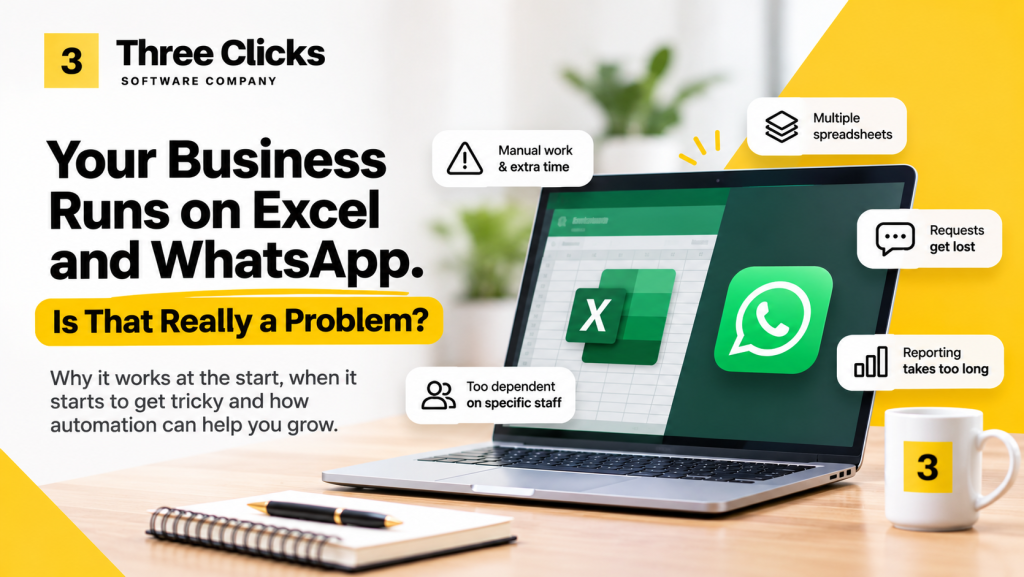
Your Business Runs on Excel and WhatsApp. Is That Really a Problem?
Excel and WhatsApp are affordable, familiar and useful. But as your business grows, could relying on them for everyday operations be holding you back?
For many small and medium-sized businesses in Malaysia, Excel and WhatsApp are essential tools.
Customer orders arrive through WhatsApp. Sales records are maintained in spreadsheets. Employees share updates in group chats. Managers request reports, and someone prepares them manually.
And for many businesses, this arrangement works perfectly well.
You don’t necessarily need expensive software to run a successful business.
But what happens when your business starts growing?
More customers. More employees. More orders. More branches. More information to manage.
Suddenly, the same tools that helped your business get started may become difficult to manage.
The problem isn’t Excel or WhatsApp. The problem begins when your business depends on people manually connecting information between them.
1. Why So Many Businesses Rely on Excel and WhatsApp
There’s a good reason these tools are popular.
They’re familiar, relatively affordable and easy to start using.
A business owner can create a spreadsheet to monitor stock without commissioning an inventory management system.
A salesperson can communicate directly with customers through WhatsApp without introducing a complicated CRM platform.
For a small operation, this flexibility can be an advantage.
In fact, replacing these tools too early may introduce unnecessary costs and complexity.
The challenge appears when the volume of work exceeds what your team can comfortably manage.
2. Five Signs Your Business May Be Outgrowing Its Current Process
Sign 1: Employees Enter the Same Information Multiple Times
Imagine a customer sends an order through WhatsApp.
Your employee copies the details into Excel, prepares an invoice in accounting software and then enters the same information into another system for delivery.
One order requires several manual steps.
When your business processes more orders, the administrative workload grows.
This also creates more opportunities for typing mistakes and missing information.
Sign 2: Nobody Knows Which Spreadsheet Is the Latest
Your sales department has one spreadsheet.
Your warehouse has another.
Your finance team maintains its own records.
Different employees update different files, sometimes at different times.
When management asks for an accurate report, the team first needs to reconcile the information.
This is a sign that your business may need a more consistent source of information.
Sign 3: Important Requests Get Lost in WhatsApp Conversations
WhatsApp is excellent for communication.
But a busy group chat isn’t necessarily the best place to manage approvals, orders or operational responsibilities.
A customer requests a quotation. Someone promises to follow up. Another employee assumes the request has already been handled.
Days later, nobody remembers who was responsible.
Without a structured process, important tasks can be overlooked.
Sign 4: Preparing Reports Takes Too Long
Suppose you operate three outlets.
Every evening, employees send their sales figures to a manager.
The manager combines the information into a spreadsheet and prepares a summary for the business owner.
This process may work, but it depends on timely submissions and accurate manual consolidation.
As the number of outlets increases, reporting can become more complicated.
Sign 5: Your Business Depends Too Heavily on Specific Employees
Perhaps one employee knows exactly how the inventory spreadsheet works.
Another understands how customer orders are tracked.
When either employee is absent, other team members struggle to continue the process.
This isn’t necessarily an employee problem.
It may be a sign that important business workflows haven’t been documented or standardised.
3. What Would a More Connected Business Look Like?
Consider a hypothetical wholesaler receiving customer orders through WhatsApp.
Current workflow:
- Customer sends an order through WhatsApp.
- Employee checks stock availability in Excel.
- Employee manually prepares a quotation.
- Customer confirms the order.
- Employee updates the stock spreadsheet.
- Warehouse receives instructions through another message.
- Finance manually prepares the invoice.
Now imagine a more connected process.
Improved workflow:
- Customer submits an order through a structured form or supported messaging integration.
- The system checks available inventory.
- A quotation is prepared using approved pricing.
- An employee reviews and confirms the order.
- Inventory records are updated.
- The warehouse receives a fulfilment task.
- The accounting system receives the information required for invoicing.
Instead of transferring information between multiple tools, employees manage a connected workflow.
The business can still use WhatsApp to communicate with customers.
The difference is that WhatsApp no longer needs to serve as the main record of every operational activity.
This is an illustrative workflow. Actual implementation depends on the systems, integrations and business rules involved.
4. Do You Need to Replace Excel and WhatsApp?
Not necessarily.
There are several approaches businesses can consider.
Option A: Improve the existing process
Sometimes, better spreadsheet structures, shared access controls, standardised templates and clear responsibilities are enough.
This may be the most practical solution for smaller operations.
Option B: Connect existing tools
Your business may already use accounting, inventory or customer management software.
Connecting these tools can reduce the need for employees to transfer information manually.
Option C: Introduce a dedicated business system
If your operations involve multiple branches, complex inventory movements or specialised approval processes, a dedicated system may provide better control.
This could be an existing software product or a custom-built platform.
The right option depends on your business requirements, budget and expected growth.
5. Where Does AI Fit Into This?
AI can be useful when businesses handle large amounts of unstructured information.
For example, customers may send orders through WhatsApp in different formats.
One customer writes:
“Hi, need 10 boxes of Product A and 5 boxes of Product B for delivery tomorrow.”
Another sends a photograph of a handwritten purchase order.
AI may help extract relevant information and prepare a structured order for review.
However, AI shouldn’t automatically assume that every message contains complete or accurate information.
An employee may still need to verify product codes, quantities, prices and delivery instructions.
For predictable processes, traditional automation is often sufficient.
AI should improve a well-designed workflow, not become a substitute for having one.
6. How Do You Know Whether Automation Is Worth the Investment?
Before introducing new software, estimate how much time and money your current process consumes.
For example, suppose three employees each spend one hour per working day transferring information between systems.
Across 22 working days, that’s 66 hours of administrative work per month.
If an improved process reduces that workload by half, approximately 33 hours could be recovered.
This is a hypothetical calculation, not a guaranteed result.
You should also consider implementation costs, subscriptions, maintenance, training and the time required to review exceptions.
A good automation project should deliver measurable operational value, not simply introduce more technology.
7. Start by Mapping One Business Process
You don’t need to automate your entire company at once.
Choose one process that causes frequent delays or repetitive work.
Write down:
- Where does the information come from?
- Who receives it?
- What happens next?
- Which systems are involved?
- Where does someone manually copy or re-enter information?
- What mistakes or delays happen regularly?
Once you understand the workflow, it becomes easier to identify what could be improved.
Sometimes, the answer is better organisation.
Sometimes, it’s a simple integration.
And sometimes, building a dedicated platform makes sense.
Final Thoughts: Your Tools Should Grow With Your Business
Excel and WhatsApp aren’t bad business tools.
They help countless businesses communicate, organise information and operate without significant upfront investment.
But as operations become more complex, relying entirely on manual processes can make growth harder to manage.
The objective shouldn’t be to eliminate familiar tools.
It should be to create a business where information moves reliably, employees understand their responsibilities and management has better visibility over operations.
The best technology is the technology that solves a real business problem.
Is Your Business Ready for a More Connected Workflow?
At Three Clicks, we help businesses improve their operations through custom software, system integration, AI and automation.
Whether you’re managing orders through WhatsApp, maintaining multiple spreadsheets or struggling with disconnected systems, we can help you explore practical improvements.
You don’t need to know what software you want.
Let’s start by understanding how your business works.